Showing posts with label pulps. Show all posts

Friday, March 22, 2013

Story Papers & Six Gun Gorilla

I don't profess to be an expert on the British Story Papers. Existing around the same time as the pulp novels in America and with similar fiction, they were thinner than the pulps. Young fans of Harry Potter might find it interesting that their great grand-parents were also excited about reading about adventurous kids and cads in school, the boys of the Greyfriars school or the girls that formed their own masked group "The Secret Three". It's also interesting just how much of the pages were devoted to the American West or American detectives and gangs. Comic and pulp fans might find it interesting just how many masked men and villains populated these pages as well such as the Green Mask vs the Black Bat!

Under their pulp fiction banner, Comicbook Plus has lately been adding of these books, including Wizard, Magnet and others.

One of the stranger characters and strangest Wild West vigilantes to emerge from this site is the Six-Gun Gorilla. A serial telling the story of a gorilla trained in the use of pistols who goes on a mission of vengeance against the gang that killed its master, an old prospector. To give the writer credit, he manages to tell this story while maintaining a certain level of credibility to it. Intelligent and capable, SGG remains thoroughly an animal in its actions, motivations, and point of view. The whole story is collected here.

Meanwhile, Si Spurrier is revamping Six Gun Gorilla for comics, the interview and details can be found here.

What is Pulp?

Which leads into a whole 'nother discussion. The interview calls Six Gun Gorilla a "pulp" character. CBR interviewers and interviewees use this term indiscriminately. Three different interviews concerning Dynamite's upcoming Miss Fury comic and all three refer to her as being a pulp character. Talking about Captain Midnight, he's referred to as a "pulp" character. Because he fights Nazis, Captain America from the movie is referred to as being "pulp". I feel like I'm constantly repeating myself over there, "Not a Pulp!" Can you imagine the next hot writer of Batman, Superman or Wonder Woman calling the character a pulp character? It is akin to me calling Harry Potter a television character, which at least would have the validity of that being where I first encountered him, in a television airing of the first movie.

None of these characters ever appeared in the pulps. Captain Midnight in particular appeared almost everywhere but: Big Little Books, Radio, Movie Serial, Comicbooks. Miss Fury appeared in comicstrips and was reprinted in the comicbooks. Not to mention, most of your hero pulps... they rarely fought the Nazis. Out of the thousand and more adventures that make up the stories of Doc Savage, the Shadow, Avenger, Secret Agent "X", The Spider, Phantom Detective, Black Bat, Green Ghosts, Operator 5, less than 1% fought Nazis. G-8 fought the Germans, but that was WWI. It's narrowly pigeon-holing pulps while using it to describe things that don't fit.

Of course the interviews then frequently go from talking about the "pulp" character to how this character is NOT that character, and it's more about the changes they are making to the character, keeping just the name and sometimes look but little else.

Pulps were not just hard-boiled detectives as some fans are wont to refer to them nor campy masked Nazi-fighters. Sure, there's the likes of Dan Turner and Doc Savage. But, it's also John Carter, Tarzan, Conan, Solomon Kane. It's H.P. Lovecraft, Ray Bradbury, Isaac Asimov, and Dashiell Hammett.

And, I think we are still surrounded by the pulp mind-set today. Not in pastiches and period fiction though and not through their first successors, the comicbook superheroes. Stephen King if he was writing in the 30s and 40s would be in the pulps. And with King, there's Lee Child's Jack Reacher, the works of Preston and Lincoln Child, Clive Cussler and associates, the prolific Dean Koontz, Jim Butcher's Harry Dresden, books of the Forgotten Realms by writers like Mel Odom, R. A. Salvatore. There's television's Monk, Psych, Eureka, NCIS, Person of Interest, White Collar, Arrow (yes, based on the comicbook character, but owing quite a bit more to the likes of pulp era characters Green Hornet, the Green Archer and even older Count of Monte Cristo). It's genre fiction rooted in the realms of possibility and wonder as well as a look at the world around us. Escapist fiction simultaneously acknowledging what we are seeking to escape from or strive against. It speaks to our fears and righteous indignation while providing a light in the darkness. It's where modern comic books and their superheroes have lost their way, they have forgotten that relationship and instead have reversed them. Their backdrops and concerns are less real world and instead canabalistic. Superheroes instead of operating in the real world, operate primarily in worlds of other superheroes. Their supporting casts and love interests are increasingly other superheroes. And, heroes are regularly killed or made into killers or other questionable choices. The heroes themselves are given some kind of "realism", saddled with feet of clay and inadequacies and failures.

Which is why I think we're seeing a resurgence in pulp today. After all, even I who grew up reading Doc Savage, it was all second hand. I didn't read my first Spider, G-8 or Phantom Detective until my twenties. Only a few out there that discovered these characters when new. Part of it is the internet, making the stories and communication between fans easier, quicker, cheaper and more widespread. At no other time would I be able to easily come across a story as wild as the Six-Gun Gorilla. Or in the space of minutes, be able to call up and read Edgar Wallace's "The Green Archer" (an excellent story by the way). I also think that the stories themselves have renewed resonance. Events such as 9/11 make the stories of The Spider and Operator 5 speak to us in ways they wouldn't have before. Wars overseas, job scarcity, government corruption, casual bigotry... the events and characters that flit across those yellowed pages seem more relevant and familiar to us than ever before. It's why the Harry Potter books were such a huge success and Steam Punk is taking off (though having been around quite for some time, all the way back to the time periods these books are set in).

Oh well, that's my rant for today.

Thursday, August 18, 2011

The Spider Too?

Dynamite released the news that they are also doing a comic featuring the pulp hero the Spider! What this means for Moonstone who publishes various illustrated Spider stories, one can only guess. Dynamite made news when they announced they were doing the Phantom which was still being published by Moonstone at the time. It took about a year, but eventually the Phantom did end up at Moonstone. However, DC doing comics with the Street & Smith characters didn't impact Moonstone's prose projects with the characters and Moonstone did a Green Hornet prose book at the same time Dynamite was doing the comic. As most of their work with the Spider could hardly be considered actual comics, it's possible that we'll see one publisher reprinting the original pulps, one doing new prose short-stories and another doing a comic.

Dynamite released a bit more news concerning the Spider comic which might give an inkling as to their approach with the Shadow. Starting with, the Spider is being redesigned by Alex Ross! It's not much of a redesign as it's basically tweaking his serial costume and it's not bad. And, it appears the Spider will be in the present day.

Neither of these is necessarily bad, but it does show yesterday's optimism to be a little misplaced.

I had hoped that maybe the company and creators might have learned something with Kirby Genesis where interviews are given to re-assure readers and fans that Kirby's designs would be left intact and effort would be made to keep to the spirit and characterization that he set forth with the characters. It seems strange to me that in today's market, that creators need to actually stress that when talking about a project, but it's the reality of the world we live in today. Where DC and other companies are trying so hard to get characters wrong and crowing about it as if that's a good thing, it's actually needs to be said that a book might be coming out with the characters looking and acting like they were envisioned by their creator.

Out of that content, these changes are not necessarily a bad thing though. In the comicbook mini-series Mystery Men written by David Liss, something that comes home is how much of today's world is like the world that the pulp heroes acted out of. I think much of what made the pulp crime-fighters like the Shadow and the Spider appealing, we have the same conditions today: racism and class inequality, the wealthy getting wealthier while the poor are getting poorer, wars and instability overseas, wealthy criminals getting off with slaps on the wrist. Handled correctly, I can easily see the likes of the Spider and the Shadow operating in the world of today. Doc Savage is the one that's harder to handle as so much of his world centered on super-science and unexplored places. Translated to today, a Doc Savage ongoing should be something akin to the television show Fringe coupled with Eureka and Warehouse 13 with clones, parallel worlds, insane experiments. But, the night avengers I can see as being just as relevant today as then (one of the things I liked about Nolan's Batman movies is that they would also be great Spider movies with hardly an adjustment, maybe even better).


The look as noted comes from the Spider's movie serials which is hardly how he looked in the pulps. The thing is, his look wasn't always consistent in the pulps either, sometimes he was just Wentworth for most of the story, with a few attempts at disguise as a crook or a simple mask. Sometimes he had a fright wig, fake fanged teeth and a hump! Sometimes he had the wig and teeth but no mention of a hump. The pulp covers were more consistent though a little more generic, but that's the way I often envisioned him, regardless of how he was described inside: black suit, cape, hat and mask and a gun in hand. However, this is a striking look that at least has precedent with the character and could serve the character well as a comicbook hero.

David Liss of Mystery Men (the Marvel comic, not the movie) has been slated as the writer. He is a good writer and captures the pulp era well in his few comic credits at Marvel. The Spider is even trickier to capture correctly by modern writers than the Shadow though. Both seem to have the problem that modern writers cannot get past the violence and the Spider is even moreso than the Shadow. But, Norvell Page wrote the character of Wentworth and the Spider as one of intense passion in everything he did. It was his passion of empathy for his fellow man, for the endangered innocents and the hatred of the crooks that cops could not touch through their cleverness, audacity or just ability at working the system that drove him to meet steel with steel at great personal risk. He operates in a world where the common gangsters are along the lines of Hitler and Stalin and can be opposed by one man if he's daring enough. There seems to be an inability of many to really grasp that, only seeing the extreme violence and portray the character as being one of questionable sanity. Once you start questioning his sanity, you really lose what the character is supposed to be about. The Spider takes great gambles with life on the line, but he's always a sane man in an insane situation. He's no more nuts than John McClane in the movie Die Hard.

I have to admit, I'm not enamored of the interior artwork presented. The computerized coloring is very evident and makes everything look a bit too pristine and artificial looking without communicating any sense of mood or atmosphere. I had forgotten to list that yesterday of among the things I tend to not like of Dynamite's books. The coloring often obliterates the line work. Which is fine if your colorist is actually a painter and painting the books, but the coloring is often obviously done on a computer by a colorist that doesn't seem to understand using coloring to communicate mood, story or even how to facilitate "reading" the illustrations and stories that are being printed over reading the comic via computer monitor. Colors are often too dark or too saturated, everything is lit as if it is being lit in a studio with harsh lights producing bright highlights and shadows on every object. Every surface has an obvious gradient to it. Backgrounds and moving objects all are blurred, every light produces lens flares. The end result is not making the art look more realistic than the old coloring methods but just unrealistic in different ways. If anything, the use of filters and gradients in efforts to make the artwork look more photo-realistic often has the opposite effect by highlighting the unrealistic nature of the artwork. It's like watching David Boreanaz acting opposite cartoon Stewie Griffin.

Meanwhile, there's no sense of movement in the panels presented. The characters all look like they are posing for photo stills from a movie set traced over in photoshop judging by the cold unvarying line widths. A comic doesn't have actual movement, a single panel often needs to communicate three bits of time simultaneously: suggest the movement a second before, the present, as well as the result of a second after. There's zero movement, mood or passion in the pages presented. It looks "realistic" but in a very staid, antiseptic way. The exact opposite of the effect you want to go for with characters like these. Again, look to Marvel's Mystery Men to see it being done right.

Wednesday, August 17, 2011

The Shadow at Dynamite

Dynamite (the publisher of Zorro, Lone Ranger, Green Hornet, Black Terror) has announced that it has acquired the rights to Street & Smith's pulp hero the Shadow. Dynamite as a company has a history of announcing things before they are finalized (The Fighting American, the Phantom), so here's hoping this one doesn't come back and bite them in the next few days.

No announcement of a set creative team but here's hoping it doesn't include Alex Ross (Other than covers of course) or Kevin Smith. The good news is the announcement talks about the history of the character but nothing about re-designs or working to make the character more palatable to today's audiences that generally pop up in their announcements and talks about classic characters. Maybe they learned something from DC's crash and burn with the pulp and Red Circle heroes. It's telling that when they talked about the Kirby heroes of Kirby's Genesis they talked about how they were keeping faithful to the designs and looks of the characters. So there's hope that they have learned something.

The biggest fear should probably be decompressed storytelling, first issues that don't have the hero in action at all. This has been part of Dynamite's general storytelling, long drawn out origin stories, writing for the trade market and not the monthly comicbook market. There should be action and mystery in the first issue.

Dynamite does have a good pool of writers and artists to draw from, but are any up to writing the character. Wagner from Green Hornet: Year One seems to have a grasp of the time period, and Francovilla has a good feel of mood and style that the title should call for. Maybe they could lure Gerard Jones and Eduardo Barreto back to comics and a character they did so well years ago.

Some wonderful preview images though.

Wednesday, April 13, 2011

The Spider copyrights?

So, I was bumming around the internet and found a reference that claimed that the first year of the Spider pulps were not renewed, but were starting with issue 13 by Argosy. This sounded a little fishy, so I checked some of my pulp reprints which happened to have a few from the first year. Now, those reprints do list a renewal of them being done in 1961.  Curious, I then checked one of my go-to resources for copyright research online. There, checking the renewal pages from the years 1960 and 1961 as well as their list of periodicals' first renewal dates, and they all bore out that the Spider was NOT renewed until the 1934 v4n1 issue (whereas the first Spider pulps were published in 1933). I wonder if the "v4n1" threw the reprinters into thinking those were the first issues? Or, is there a gap in the research? Someone's obviously making a mistake. Pity I don't have another trip to DC and the Library of Congress planned anytime soon.

Does have me interested in trying to read the Spiders reprinted so far in actual chronological order. I'm not even sure if I have read the first one or not.

However, my next review will either be the G-8 novel "The Beast Staffel" or the first two Avenger novels, all of which I've read in the last couple of weeks. Currently reading Secret Agent X adventure "The Curse of the Mandarin Fan" which has been highly enjoyable so far.

Tuesday, April 5, 2011

The Spider: In Comics & Pulps

The Spider in Comics.

The Spider - Moonstone has recently released two different comics featuring the pulp hero, the Spider. I've not been enamored with their illustrated prose versions of the character. To be fair, the Spider is a difficult character to capture in comic form. He's violent in a similar way that the Shadow is violent. However, the worlds the two operate in are very different. The Shadow takes on gangs, his opponents are frequently the Al Capones of the world. In the Spider's world criminal empires are headed not merely by brutal and murderous men, but by socio-and psychopaths. They kill in fantastic and horrible ways, using terror and destruction of the social order in order to gain their goals of power and financial gain. Which is what trips most writers up, they see his over-the-top violent and insane world, his own passion and confuse the two. The violent insane style of the stories gets identified as part of the Spider's character. This shouldn't be the case. The Spider should be a passionate man and willing to kill, but he shouldn't seem to be any more insane than Willis' character in Die Hard or the Shadow in his stories.

The first issue of what I assume will be an ongoing comic with a cover by Dan Bereton and story by Martin Powell and Pablo Marcos really manages to deliver the goods. It pits the Spider against a mad surgeon and his Frankenstein-like monsters, showing an understanding of the secret of the Spider is he is normally pitted against extreme and monstrous foes, in this case quite literally. Several Spider stories deal with turning normal people into monstrous and mindless foes, so this seems a natural fit. Overall, the story seems almost a merging of classic DC horror/thriller stories from the 1970s with Batman, but not quite achieving the final polish to push it beyond being pretty good to truly memorable.

Part of it may be the length as the comic also features another pulp hero, Operator 5. A character I've not really gotten into in the pulps and the first chapter of the story here doesn't really grab me either.

Moonstone also is re-releasing Mark Wheatley's Spider comic story "Burning Lead for the Walking Dead" though with some slight tweaking. Like Powell's story, this one is a monster/horror story though more of the human variety, where a villain seeks to subvert and destroy the underpinning of human society and culture.

Wheatley's comic is longer and is especially strong. His artwork at times reminds of the stylish Tim Sale. Out of his Spider garb and in tattered shirt, Wentworth looks like he could hold his own against Doc Savage. Many elements of the pulps find their way into the comic and as a stand-alone, it works as a very good comic pastiche of the pulp hero. We have Kirkpatrick suspicious but unable to prove Wentworth is the Spider, yet the villains having no trouble with piercing that veil, a very common theme. And, while Wentworth wears the Spider garb, for much of story he is forced into action as himself yet somehow able to preserve the fact that he and the Spider are two different people.  As an added bonus, Wheatley talks in the back how the story came about and his love for the character and pulps (constrast that with how Azzarello talked about Doc Savage and the pulps).

Both comics feature the Spider as he's sometimes described in the pulps but seemingly at odds with how he appeared on the pulp covers. The pulps were never totally consistent with the Spider's guise which at times also included false fangs and hump. As I noted, many times he went into action in disguise or even as Wentworth, just leaving no survivors to tell the tale. Moonstone's version is a compromise between the descriptions in the story and the pulp covers by including a dark wig from the stories and the mask on the covers. Wheatley's original version of the comic was with gray/white hair and sans mask. In my own mind's eye, I tend to see him as the covers depict him, as those images were often powerful and iconic looking.

The Mayor of Hell: Girasol Collectibles does the "Pulp Doubles" reprints of the Spider and #15 delivers two powerful Spider tales with one of those wonderful covers I mentioned. What's especially great about this cover is that while it's actually to the second story and illustrates a scene from it, it also works thematically for the first story (and is a far more powerful cover than the actual cover for "The Mayor of Hell").

If I was giving a Spider pulp for someone to read as an introduction to the character, it wouldn't be "The Mayor of Hell" (#28, January, 1936). It takes many of the elements of the Spider character and cranks them all up several notches to the point that it's as comparable to many of the standard novels as the standard ones are to the Shadow novels. It is a rollercoaster of a read though and never is the character so hard-pressed against a criminal organization.

Girasol doesn't print these in order and my reading of them is not even in the order they print them so it is a surprise that Kirkpatrick here is not Commissioner, but Governor of the state! Although, this seems a status quo that the novel is setting out to rectify as he's impeached on trumped up charges and the current Commissioner seems a pawn of the villain.

The story starts off strong and never lets you go. Wentworth is at home relaxing and playing the violin when there is an assassination attempt on his life followed by cops come to take him for being the Spider, dead or alive.  Beset by two groups of foes, each eager to kill him and trapped in his burning home becoming an inferno, there are pages of him and his men battling to stay alive. That the cops themselves seem murderous and corrupt, he's forced to go against his long-standing policy to not fight the police. It's pages of violent action that ends with his aides captured and he is badly wounded and believed to be dead!

Often the stories have him badly wounded but bravely fighting on, but here he is taken out of the action early on. Cared for by an elderly man, his daughter and ex-cop fiance, it is six weeks before he is lucid again. They don't know his identity, but are bitter at the police and at first seem just common crooks, an irony not lost on Wentworth. Overall, it's two months of him out of the action, rebuilding his strength while the Mayor of Hell takes over the city government, the police and the newspapers. With the Spider and Wentworth believed to be dead, he takes on a new identity, that of Corporal Death and with his new allies, tackles the corruption and men of the Mayor, actively warring on the police. His face bears the scars of his ordeal, to the point he's not readily identifiable as Richard Wentworth or the Spider.

The battle is a long and arduous one. His new allies are soon taken from him as well, a disgraced Kirkpatrick is on the verge of suicide and Wentworth must seek allies in the form of one brave small newspaper to ferment a revolution of the general populace to re-instate Kirkpatrick as Commissioner.

Even after the story ends, it doesn't resolve the dilemma of the Spider's death, his new identity or his facial scars, the old status quo has not been completely re-instated. A pity that the second story in the reprint is not the next issue.

Fangs of the Dragon: By comparison, "Fangs of the Dragon" (#107, August, 1942) is almost forgettable. The mystery is one that might confront Doc Savage or the Shadow as Richard Wentworth aka the Spider goes to the relatively small town of Bethbury to investigate what seems to be an outbreak of murderous criminal insanity among normal people. This disease of crime seems to be transmitted by flying glowing dragons.

What helps set it apart is the language and storytelling is top-notch, from the impending horror on what seems a normal every-day evening in an average to the description of the Spider swinging through the night sky with his cape billowing out behind him. Also on hand is Nita Van Sloan, always one of the more capable and brave of pulp heroes' love interests, in this case insisting on fully sharing the dangers and missions of Wentworth and showing herself of capably mimicking his disguised features. I've read other stories where she dons the garb to distract the police and criminals, this is written as if it's the first time she does so.

There's a great series of scenes that's pure pulp/movie serial genre as the Spider is pursuing a foe through the villain's headquarters and must pit himself against all sorts of outlandish death-traps. Who would design a building like this, that would almost surely kill you or your henchmen someday not to mention would actually hinder any kind of quick getaway? But, it makes for exciting reading as the hero must pit both body and mind to just trying to stay alive in a situation that he cannot solve by simply blasting away with his guns.

The story is thematic similar to the first one in that in both the Spider has to contend with the possibilities of corrupted city governments, that he must not merely fear the system doing its proper duty, but the turning of it into a nigh unstoppable criminal machine devoted to his destruction. And, both feature prominent to their plots, the death of Richard Wentworth!

Wonderful reads!

Thursday, December 30, 2010

The Monsters are Coming


To start off, for people that might stumble to this entry looking for the DC comic titled Secret Six, written by the usually excellent Gail Simone. As a name, the Secret Six has a long history. With DC, there are two teams predating the current team of villains. The first team was of various normal people, with specialized talents: a magician, a boxer, a scientist, and so on. Each is being blackmailed by a mystery-man calling himself Mockingbird who may be one of the men or women that makes up the group. In a unique twist, the identity of the blackmailer is kept a mystery and is still unrevealed when the series reached an untimely end. In the late 1980s where it became popular to treat characters from the 50s and 60s as being in "real time" and killing off and replacing heroes with modern versions, the original Six are brought out of retirement and sent on a flight that results in their deaths. However, one seems to have survived as Mockingbird recruits an all new team, including a son of an original member. The new six have robotic enhancements so that each has a singular special power. The mystery of who killed the original team and who really is Mockingbird is finally revealed.

But, before that, the Secret Six was a pulp series from the latter half of 1934. History takes a strange turn as the name precedes the pulps. The term was also used by a group of Chicago businessmen that were interested in toppling Al Capone. Before then, it was used by a group of men siding with Jim Brown and the abolitionist movement.

If you're still reading, DC also took the name Suicide Squad from a pulp team of characters.
The early 1930s saw the birth and explosion of the hero pulps and the pulp superhero: The Shadow, followed first by the Phantom Detective and then Doc Savage a month later in 1933. In 1934, Popular would turn to dependable Robert Hogan to create The Secret Six, a book that featured a team of characters having the larger than life adventures not too disimilar to those that would find the Shadow or Doc Savage.

The chief difference is that the Secret Six did not have the charismatic and superhero leader. In many ways they are akin to DC's later non-Super teams such as the Challengers of Unknown and Sea Devils. While there is a leader of the group who is a better detective, better man of action, better looking, etc., there's not this large gap of ability between him and the others. Also, much like several of the DC teams and even Doc's own group of aides and the Shadow's agents, the various members of the Six are specialists.

The Secret Six are:
King: The leader of the group. A young man of action, barnstormer pilot, previously on death row and sought by police for a murder he didn't commit.
Luga: Large Zulu chief and King's servant and regular cook for the Six.
Key: Possibly the one member of the group that really was a crook and is now reformed. His contacts provide the group with much of their information on the movements of the police and underworld. A master burglar and safe-cracker. A man of slight build.
Bishop: The moral center of the group who seems genuinely religious and keeping the group on the straight and narrow, to the point that they even try to curb their use of swearing. Built along the lines of the stereotypical portly Friar Tuck mold
Doctor: The scientist of the group, in both medical and technology.
Shakespeare: Master of disguise, he disguises the Six for undercover work.

They are also helped by:
The Dummy: A deaf man whose hearing has been restored and feeds them information overheard in Police Headquarters.
Legs Larkin: A former criminal contact of the Key's feeding him information on the Underworld
Flo the Fleecer: A beautiful gold-digger and possible con-artist who is attracted to King.

The Secret Six are all wanted for crimes, although it's possible that only the Key (and his contacts) actually has a past life of crime. As such, their old names and past lives are foresaken and they make their headquarters in an isolated cabin with enough grounds on which to keep their own plane. It's not clear how they make the money needed to feed themselves and operate their vehicles. In this sense, one can see familiar lines that Hogan followed from his most popular series G-8. Like the Six, his real name is never revealed and while very competent, he's not quite along the superhuman lines of Doc Savage, the Shadow, or even the Phantom Detective, Secret Agent "X" and the Spider. He needs the help of his assistant Battle to create the most convincing disguises. And, like G-8, at least in this novel, there are scenes of the groups sharing meals together, a possible theme or belief of Hogan's: the importance and communal nature of sharing meals, illustrating the idea of the group to be more than just friends but a family created by necessity and common goals.

However, The Secret Six didn't prove to be a success story, only lasting a few issues. This may be due to the generic and normal nature of the lead. Or it could be due to Hogan not really exploiting his large cast to the fullest extent. Other authors of the other books didn't need to use their full casts. Dent quickly rotated Renny, Johnny and Long Tom in and out of the Doc books, focusing mainly on Monk and Ham. By nature of the title, one expects to see the full cast. Most of the Six are barely cyphers, given a few small tasks or lines but that's it. Nor does Hogan physically describe the characters each issue or explain their relationships and why they do what they do. This works fine in a series like G-8 where the backdrop of the War and that he's a spy is enough to know of the set-up or a case like the Shadow where the character and his origins are supposed to be mysterious. But, most of the hero pulps took pains each issue to treat the hero as if it might be the reader's first encounter with him. Hogan doesn't write that way here nor in the Wu Fang novels which tend to make the recurring characters non-descript.

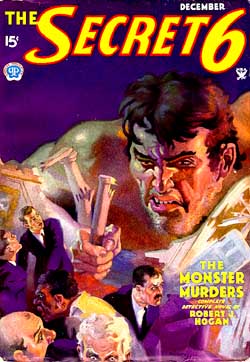
The advantage is the plotting of the stories. "The Monster Murders" is from December 1934, featuring a cover of a giant ripping the roof of a building and the Six scattering. A couple of the Six are on a walk when they come across dogs the size of horses running wild in the streets and aid the authorities in routing them. Meanwhile the Key and his contacts bring the Six a case of suicide and possible blackmails. As this puts them on the trail of two men, one over 6 feet and another over 7 feet, which leads them to even taller men that are impossibly tall, Key's case and the giant dogs seem obviously linked. And, it culminates in an exciting explosive finale. It's an exciting story, focusing mostly on the efforts of King and Key (who shares some of G-8's aide Nippy's sense of humor).

The reader will probably be ahead of the Six on figuring out a lot of what's going on in the story. And, with the science fiction plot, the fact that the Doctor is so under utilized other than as a Doubting Thomas and complain is a bit maddening. It makes him seem as if he doesn't bring that much to the table where the team is concerned in a plotline that you'd think would give him a lot to do and take a bit of the center stage. Another problem is that King and the team don't really treat the giants as "impossible" and follow up on the leads that it suggests or the obvious links to the giant dogs until near the end. It's one thing trying to find someone that's over seven feet tall, but once the giant is ten feet, eighteen, or forty, you're entering the realm of something un-natural going on. But, they continually approach it as aberrations but not necessarily un-natural.


An interesting aspect of the novel is the name, "The Monster Murders". One of Batman's earlies adventures pitted him against Hugo Strange and his giants, also identified as monsters in the story's titles. Most attribute this similarity to the Doc Savage novel "The Monsters", the cover featuring Doc being held in the grip of a giant hand and Bob Kane and Bill Finger are known to borrow from the pulps. This Doc novel has proved to be one of the more popular and enduring. Of all the covers, this is the only cover that Bama faithfully follows in his cover of the reprints. The story was also used to adapt for a radio script and was adapted in the 1970s Marvel color comic series with covers by Gil Kane and lush interior art by Andru and Palmer. The Doc story was first published in April, earlier the same year as the Secret Six novel. Is this a case of  Hogan borrowing from the Dent novel? It's possible that he was not as taken with Dent's efforts as Doc didn't really have to deal much with the giants as much in his novel, more with the gangsters behind them. Here, the team and society in general seem genuinely threatened with a nigh unstoppable threat, the Six outmatched.

Or, it could be a case that there's something in the water to prompt two stories of giant "monsters" in the same year. A little thing that was called King Kong in the theaters just the year before. In fact, the climax of the Secret Six novel seems taken right from the movie with the giant taking a lovely blonde as a prisoner and foresaking a cure in the hopes of making her the queen of the world and fighting attacking planes to the death.

There's even an earlier precedent to both of these novels. Three decades earlier, H. G. Wells writes the novel "The Food Of The Gods And How It Comes To Earth", dealing with humans transformed into giants and ultimately a war between them and the rest of humankind. In fact, "The Monster Murders" could be taken to have elements of another Wells novel, "The Island of Doctor Moreau".

Wednesday, December 15, 2010

The Mysterious Wu Fang (and Robert J. Hogan, too)


I finished reading two Wu Fang novels by Robert Hogan and have started an issue of The Secret Six. And, with the arrival of my new laptop, had hoped to bang out a review of the novels. Usually I like to start with a little background on the character and writer. Which was where I hit a snag.

Robert Hogan is a bit of an anomaly in the pulp authors' circle. Like Lester Dent, Walt Gibson, and Norvell Page he wrote a character pulp, the principle guiding force behind the character. For 110 issues, he wrote G-8 while the aforementioned contemporaries wrote Doc Savage, the Shadow and the Spider. Like those titles, G-8 has made a couple of forays into comics, several attempts at reprintings of his stories including some with excellent covers by Jim Steranko. However, Robert Hogan and his character were different from them in a significant way. One, I recall no mention of him using ghost-writers or what, if any, editorial involvement may have played in the creation of the character he is principally known for. Two, from the start, Hogan had his name on the cover. Every other major character pulp of the time was published under house names and pseudonyms. Yet, Hogan wrote at least three different title series under his own name: G-8, Wu Fang, and The Secret Six.

Maybe it's some ironic twist of fate, that the one author of the major hero pulps that wrote and was published under his own name is the one that the least has been published and written about. At the time of this writing, I'm newly married and most of my research books are at my old house a couple of hours away. But, I couldn't recall a single personal detail concerning Robert Hogan or behind the scenes of his stories. Yet, I can tell you that the creator of the Green Lama did magic tricks. Looking online for biographical data on Hogan was fruitless. The name is too common by itself, and coupled with his works bring up a lot of information on his books and characters, but nothing on him or his writing. Maybe it's the fact the other writers did slave behind house names that fueled interest in doing scholarly research in ferreting out the details behind the principle writers and their ghosts and replacements. As we are going through a revival of interest in the pulps and the characters, with several comic book companies trying new adaptations of them and more pulp reprints being offered than before, there is still precious little being written about G-8 and his creator.

As shown with The Octopus, Harry Steeger, the publisher of Popular Publications seemed convinced that a villain centered pulp was viable. Looking at the success of Fu Manchu, an Asian menace was opted for, Wu Fang. Robert Hogan was tapped to write it. It lasted a mere seven issues. Later, they'd try again with Dr. Yen Sin by a different writer and with even less success.

Wu Fang was a Chinese criminal mastermind who had designs for conquest, especially of America. He was a member of a few secret societies and had loyal henchmen of various races, most notably Chinese and Malaysian, and spies placed in key positions. He was a scientific genius who specialized in breeding various hybrid creatures that were intelligent enough to be trained as well as what could best be described as hybrid monkey men. He also had an assistant who claimed to have an ancestor as an ape, perhaps an early experiment of Fang's. He seemed to have a weakness for exotic white women and was able to exert some mysterious control, perhaps through brainwashing over them. There are two that we know of, Mohra and Tanya, both of whom would betray him after falling in love with his foes.

Wu Fang was most frequently opposed by Val Kildare. Kildare was more than likely somewhere between 30 and 50 years of age and well travelled. By the first novel, he had opposed Wu Fang several times but fails to capture him which leads to his official dismissal from the FBI, though he's allowed to keep his badge. He still enjoys some kind of  authority and he's referred to as being ex- Secret Service as well, but most frequently just as a "government man". Kildare is helped first by reporter Jerry Hazard and later archaeologist Rod Carson. Newsboy Cappy also serves as eyes and ears on the street.

Hogan was a good action pulp writer. With G-8, he showed that he could excel at realistic battle and action as well as thinking up outlandish plots. While fighting WWI, G-8 did the usual spy stuff but he also fought lost races brought to fight on the German side, bizarre death machines, science fiction weapons and devices and some that were merely mundane devices decked out with supernatural overtones. He brought that creativity to his writing of Wu Fang, thinking up fiendish tortures, outlandish creepy creatures created and controlled by Wu Fang.

Yet, the novels are lacking when it comes to the heroes and basic set-up. I've only once tried to read Rohmer's Fu Manchu and was bored by it. But there are familiar tropes that are carried through here. The Oriental criminal mastermind, the White government agent and his sidekick, the woman working for the villain but in love with the sidekick and her loyalties divided. Hogan doesn't only follow the trope, but he repeats it when he introduces a second sidekick, Rod Carson and his love-interest Tanya while Hazard is forced to retire with Mohra by his side from the fighting due to injuries received while being tortured by Wu Fang. What Hogan doesn't do is really describe the heroes or give them compelling characteristics or memorable traits.

To look for in depth characterization and motivation in most of the pulp literature would be a mistake, characters are painted with broad strokes, their appearances going hand in hand with their natures. Dent excelled at giving little character or personality bits to his characters to make them memorable. In the G-8 novels, Hogan wasn't often subtle but each of the principal characters were memorable in their own way. G-8 being the most generic, he had a favorite album he played to help relax and was sometimes given to philosophize over the nature of War, how some of the enemy he'd gladly meet over drinks in a cafe if times were different. Bull was large, loyal and a bit superstitious while Nippy was deft with his hands, cunning, witty, and a practical joker. That's all lacking here. We are told in "The Scarlet Feather" that Hazard is visibly younger than Kildare and that he's athletic. A similar description is given to Rod Carson in the other novel. But, that's it. The two are interchangeable and serve the exact same functions in the novels, following along on identical paths though the two men hold two entirely different jobs, Hazard is a crime reporter (and a detective in his own right) while Carson is an archaeologist. But, both talk with the same voice. While being the hero of the stories Kildare is described as an ex-FBI agent or Secret Service agent depending on the novel but still exacting some kind of authority. Otherwise, he's completely a blank slate, bumbling as often as the supposed sidekicks. His main trait seems to be able to be calm and not swayed by the attractiveness of the women while his chosen helpers are excitable and love-sick. The most distinctive of the lot is the plucky newsboy Cappy who helps them with information and even saves their bacon a time or two. Normally I don't like it when kid characters come on the scene as active participants in the stories, but here he's a breath of fresh air, his exuberance jumps off the page.

Of course, Kildare has other things against him that Hogan couldn't foreseen. He's so generic a character, it's hard to not mentally see his name and not think of either Dr. Kildare or Val Kilmer as you fish around for some characteristic or visual image to hook on him.

The traitorous women Mohra and Tanya don't fare much better. They are given little to do other than to look pretty and fret over whether to help their boyfriends or the mysterious crime-lord who holds some control over their lives. Mohra is described as being both exotic looking but also as a "white woman".Tanya is described as a blonde and speaks in a foreign accent. Another novel claims she comes from a royal family, kidnapped by Wu Fang.

Nee-Sa is a young Asian girl that also works for Wu Fang, although in her case it might be willingly. As such, her evil is a bit unsettling and un-natural and in "The Case of the Black Lotus" she disappears from a scene by possibly turning into a bat!

Which takes us to Wu Fang himself. In other novels and stories than the ones here, we get more background on the man and just how far he will go. For that history, I'll just point you to Rick Lai's outstanding article on him and Yen Sin. Yet, at least in these particular novels, we don't get much focus on the villain, he remains in the background, a motivating force until the end. Likewise, we have a lot of hybrid creatures and strange tricks such as Nee-Sa possibly turning into a giant bat, but little explaining how it's done or scenes of the man working in his lab, directing his minions, etc. He is as generic a menace as Kildare is a hero. Which sets up a vicious cycle. As we don't really see Kildare stand out as a detective ala Holmes, or mental/physical epitome ala the Shadow, Doc Savage, Jim Anthony, he never seems that big of a threat against Wu Fang. Likewise, Wu Fang never really shines as his opponent isn't all that special a character himself. It is interesting that one of the two novels I read actually used the term "Yellow Peril" in describing him as a character.

"The Case of the Scarlet Feather" and "The Case of the Black Lotus" are the second and sixth novels of the series. In "The Case of the Scarlet Feather", Wu Fang is up to something strange as he tips Val Kildare and Jerry Hazard to a plot to kill a cargo ship's cabin as well as an escape attempt by men he's holding in the ship's brig. Both events happen as planned, and seemed link to the theft of several caskets, the men involved being identified as foreign agents. Kildare soon discovers that it's linked to the formula for a powerful gas, recently discovered coating a scarlet feather in an Egyptian tomb.

"The Case of the Black Lotus" has Wu Fang usurping control of a secret Chinese society Chang Li, and using their sacred black lotus flowers as death symbols, pinning a widespread campaign of murder and terror on the leader of the secret society. Val Kildare, with the help of Jerry Hazard and archaeologist Rod Carson delve into the underground societies of Chinatown to find Fang's lair and stop him.

Both cases have mounting danger and bizarre menace through the various creepy hybrid creatures under Wu Fang's control. Both have intense scenes of the heroes trapped in buildings and allies getting killed one by one. While Hogan is not one for actual atmosphere, he describes action and settings with clarity. Wu Fang is a torturer and Hogan ably displays that without actually getting too graphic with the details, showing a possible talent for writing for some of the more graphic pulps. Interestingly, both covers feature the prominent method of torture in each story.

"The Black Lotus" is not the novel that Rod Carson and Tanya debut in, but their roles feature heavily as this is the novel that climaxes with Jerry Hazard being tortured to the degree that he may not fully recover for a long time if ever. If he and Mohra did return, it was in an unpublished adventure. Rod's plans for an archaeological expedition seem indefinitely derailed in his joining Kildare for the fight against Wu Fang and rescuing Tanya from his control.

Both novels are wonderfully illustrated, the first by Richard Flannagan, the illustrator of the Fu Manchu novels, and the second by Franz Plachy. Plachy wasn't as atmospheric as Flannagan, but he seemed to love drawing the heroes fighting scores of villains in exotic if cramped quarters and I prefer him over the other.

The end result is that as it was a short-lived series, I wouldn't mind reading the others, especially to get more of Wu Fang's background and character. Hogan is a master of plotting and telling a story, the adventures move at a break-neck pace. At the core, there's some interesting things going on with the characters that don't quite develop. As a steady diet, I'd probably find the blandness of the characters a bit tedious though wishing for Wu Fang to take on someone like Sherlock Holmes, the Shadow or the Green Lama. These two novels were reprinted in 1997 and 1999 by John Gunnison's High Adventure series.

Monday, November 1, 2010

Jim Anthony: Bloated Death


In reviewing the pulp story I have with the character Thunder Jim Wade, I talked a little bit about the Doc Savage clones or wannabes. Jim Anthony is another that falls into that category. He started off wearing his pedigree on his sleeve though in later stories, he became a little more down-to-earth (as much as pulp heroes get), though a bit more the hard-boiled adventurer. Like most of the would-be Doc Savages, he never proved to be the break-out success that Doc was but he managed to last over 25 issues over the space of three years in the pulp Super-Detective (not to be confused with the Ghost's first few pulp issues called The Ghost Super-Detective and published by a different publisher).

I find Jim Anthony to be to Doc Savage much like the Spider is to the Shadow. The obvious parallels are there, but both Anthony and the Spider are infused with a passion that is lacking in their inspirations. Both are more prurient in their approach to men and women and their relationships. Doc and the Shadow acknowledge that men want to date women, Monk and Ham being notorious skirt chasers after all. Still, it's all done chastely. Jim Anthony and the Spider stories recognize the sensuality, the "why" of the chase. Women aren't merely being lookers, but give off heat when sitting close. Passionate kisses and embraces are given and received. In those sensibilities, it's taking a PG aspect of the Street & Smith characters and taking them to PG-13. In this particular novel, it mentions a female character as being flat-chested, a specific description that wouldn't occur in most other books.

This helps differentiate Jim Anthony from Doc. He has Doc's intelligence and ability, but he's also more human though not necessarily more enlightened. While Doc seems to do all his work as charity since he has a steady supply of gold, Jim Anthony has made use of his abilities for his own gain. Like Holmes, he has authored articles on criminology. He holds records in various physical feats such as running the marathon and swimming. He's made countless inventions and one doesn't doubt that he's added to his fortunes over the years through patents and such. He still fights crime and punishes criminals for free, but he doesn't come across as being all that shy about being recognized for his abilities despite his protestations of not understanding why exactly he'd be considered a celebrity.

Another aspect that helps make Jim Anthony interesting is his back story. He's the son of an Irishman and Native-American princess and as such, he embodies both cultures. He's a master of all civilized sciences and modern reasoning (with a bit of the Irish fighting spirit, but that could be just me reading into it). However, he's also a throwback to the more primitive culture and man and their closeness to nature, with the physical body and abilities that allow them to survive where modern man has grown soft. He possesses a sixth sense, an ability attributed to the animal kingdom and primitive man that allowed them to sense when danger is near. In many ways, he's exactly as a reporter compares him in this novel when he decides to go on a camping/hunting trip, Superman crossed with Tarzan.

Also interesting to note, when Bantam started reprinting the Doc Savage adventures, they hired James Bama to do the covers and history was made. While Bama produced a Doc that wasn't actually described in the books, his painting of him with the widow's peak, the torn shirt that displayed a massive physique became the default look of Doc Savage. He looked like a man capable of much that the novels would have him do, a superman. Well, the writers and artist of Jim Anthony seemed to recognize that concept from the beginning. Jim Anthony liked to do much of his adventuring with as few clothes as possible and still not get thrown in jail. This allowed the interior artist to draw illustrations featuring a muscular and burly hero clad in nothing more than his shorts and with a physique rivaling most superheroes. It's a bit surprising that he never made it into comics in the 1940s since he was already visibly designed along those lines unlike Doc, the Phantom Detective, the Avenger, etc. Subtle, he wasn't.

The plot of "Bloated Death" gets the ball rolling when Jim Anthony feels the need to take a vacation, to get away from civilization. The only problem he has is that no one (ie the press and public) seems to understand that he really wants to get back to nature and truly rough it with no more than what he can carry into the wilderness. He has no intention of carrying modern gadgets, staying in a lush cabin with indoor plumbing and staff to wait on him, etc. Among many of the visitors to try to sell him something or get an interview, are a couple offering him a cabin in the Canadian Northwest. They are intent on getting him to go and thus layer their offer with other inducements to spark his interest. The wife leaves a little note intended for him to find telling him to stay away. The photo the husband leaves of the cabin shows on enlargement the image of a couple being hanged in the background. Of course, he plans on investigating (though denying to his friends that he will), just on his own terms.

Originally forbidden to go, Dolores manages to bribe Anthony's grandfather into switching places with her so that she accompanies Jim Anthony to the wilderness. Once there, the two find an Indian tribe that try to kill them in addition to a group of crooks, strangely bloated corpses and a deeper mystery involving a process of transmuting gold to a cold liquid form that allows for easily smuggling and a lost gold mine.

The set-up in such broad strokes reads exactly like a Doc novel. Several involved with either him or one of his men trying to get away for a vacation or in some location on unrelated business or simply people trying to lure Doc somewhere on false pretenses. The Pacific Northwest was also a common-enough theme in several Doc stories. Add in a science-fiction angle/rationale and a savage race/group to contend with as well as the crooks.

The surprise is, it actually reads as well as most Doc novels. The banter and humor between the aides are absent, but then Jim Anthony is more loquacious than Doc. The author's writing has a bit more of a wry humor to it and less situational/slap-stick. The villains are varied and well done, allegiances are unsure at times and the prospect of betrayal lingers just beneath the surface. In fact, I would have liked to have seen them played up a little more, the last couple of chapters beefed up some in that regard.

Taking Jim Anthony into the wilderness without access to gadgets and weapons works really well. The writer not merely tells us that Jim Anthony is capable of fantastic feats, but with each little "factoid" of some fantastic aspect of his past is coupled with him duplicating or exceeding it in the woods. We see Jim making use of his dual nature/culture as he must use woodcraft and his scientific knowledge to bring out and preserve fingerprints without access to his laboratories. The writer shows us Jim Anthony being smart, accruing evidence against the crooks while setting the odds against him. It's the pulp equivalent of crossing Survivor with C.S.I. and it helps to make the story stand out.

Modern readers will probably find the Indian tribe as being offensive and politically incorrect. They are portrayed in a very stereotypical manner. I will warn people to let go of a few of their preconceived notions when it comes to such portrayals though. In some ways, Jim Anthony himself is an example of modern portrayals of Native races, ie that he is better than civilized man because he shares that closeness to nature, he possesses a nobility and purity of spirit and lack of hypocrisy of modern man as well as the physical perfection that comes from being closely tied to nature vs civilization. More importantly, don't confuse today with the past. 1940 was not the same world today as it was then. Many places didn't have indoor plumbing, electricity and remote places were far more prevalent and would indeed come across resembling from something almost a century earlier than compared to large urban areas. It was a completely different culture than now in places. Many people, especially minorities were not educated and with ignorance DOES come superstition. And, if most people that portray natives as "Noble Savages" actually went and lived with them for extended time in that pre-civilized environment, they would probably find that they are indeed more of the latter than the former. Harsh living requires harsh rules and harsh consequences for those that disobey them. It's amazing really just how much the world has changed in the matter of two generations in terms of culture and how we see the world. However, I agree the portrayal here of the tribe is sadly negatively stereotypical which is typical for the time, but it doesn't make the portrayal by default inaccurate or all that far-fetched. What the novel doesn't do is make the crime of literally equating culture to race and making a value judgment based on that circular logic (and thus the superiority or inferiority of the culture is directly linked to whether the race is viewed inferior or superior which is reinforced as being superior and inferior because of their culture). Which is what gives this book its odd dichotomy. It portrays the culture negatively with stereotypes, but Jim Anthony's basic background is one of portraying the race itself in a generally positive light. It never really goes far enough either way to nail it down as being outright racist or groundbreaking. Like it's approach to women, it's a bit more developed and adult, but it's still just as thoroughly unenlightened.

Despite that drawback, it is a great read and reprinted recently so easily available by the folks of Adventure House. Makes me want to hunt down and re-read the other sole reprint of Jim Anthony's I have, one of the later stories titled "Mark of the Spider".

Tuesday, October 12, 2010

The Octopus

The Octopus is an oddity on several levels. One, the title character is that of the bizarre villain featured in its pages. Several times during the pulp years, publishers tried putting out pulps that would contain recurring villains, several of them in the Fu Manchu mold. And, no doubt, the enduring popularity of Manchu as well as characters and books like Fantomas, Frankenstein, and Dracula all suggested that a series based on a recurring villain was feasible.

Two, the first and only issue of the pulp is given as being Vol. 1, #4, suggesting three earlier issues featuring the character is out there. This is not the case. According to Robert Weinberg, it is believed that probably the book is a continuation of Dr. Yen Sin, another failed villain pulp put out by Popular.

Three, the villain's next appearance doesn't happen. Apparently he didn't set the world on fire so the story that was to follow this one, had the name of the villain and pulp changed to The Scorpion. The Scorpion failed to catch on as a villain as well. However, both names would prove popular for villains over the years. There's easily a half dozen Scorpion villains in the comics and movie serials of the time. Fewer Octopi, but his latter day namesake Doctor Octopus is far more popular than all combined.

When I first read the story, I knew it was supposed to be by Norvell Page, the writer behind many of The Spider pulps. Stylistically and thematically it is very similar to the more famous series with much of the same beats and rhythm. The Octopus is wilder though, it's The Spider with the dials cranked up to eleven. There's a rawness to it, that I thought it came first before Page had refined his style and plotting.

However, that's not the case. The Spider was started in 1933 with Page coming on board soon after. The Octopus was published in 1939. Instead of a progression, the Octopus character and story suggests some kind of regression. It's an explosive release of unbridled creativity and writing, piling improbability upon improbability, delivering it to the reader through purple prose and force of will, defying credible disbelief and logical plot progression and extrapolation.

Take the hero, Jeffrey Fairchild. Rich and trained to be a doctor, he runs and operates a clinic under the guise of a kindly old doctor improbably named Dr. Skull. He is also the lethal vigilante known as the Skull Killer due to his marking his victims much like the Spider. He also has secret tunnels between the hospital he helped fund as Fairchild and Skull's clinic. In an unusual twist, he has a pampered crippled brother who is overly critical of Jeffrey but whom Jeffrey bends over backwards to help and is trying to cure as Dr. Skull. Also a bit different from the usual is the would-be love interest Carol Endicott. Instead of coming from the best families, she's from the slums and was persuaded by Jeffrey to trust Dr. Skull who'd give her a job and security. This is a woman who is a bit cynical due to a hard life. When she tries to use her father's gun which blows up in her hands she ruefully thinks, "Poor old Pop! He'd come back from over there with an army gun and a lot of faith in nothing at all. Other men gave their lives, and Pop had given his soul... She might have known he'd never leave her anything useful!" In a roller-coaster story, it's a throwaway bit of deft humanizing characterization.

The villain is one of the most bizarre humanoid villains to grace any pulp. His description is often vague, describing more of the horror than his actual form, leaving it to the imagination. The end result is of some kind of Lovecraftian being in almost human form. What bit of visual description tells us that he has six octopus like limbs instead of a pair of arms. The text implies that the eyes of his mask glow, but the artwork shows it to be lights on part of his bulbous mask. The story at times almost suggests that somehow a Dr. Borden is the Octopus, but it never implicitly states it or how he managed such transformations. However, by the end of the story Borden has disappeared from the pages, no reference of his final fate.

Using ultra-violet light treatments, the Octopus has discovered a way to devolve people but not to bestial, ape-like beings. Instead, their blood is broken down to being like sea-water, their bodies and tissue also breaking down to more gelid matter. Their minds become more primal and violent and coupled with the changes to their blood, they become vampiric. Even though they need and crave the blood, they need regular treatments of the ultra-violet light even more. It is with this that the Octopus begins his reign of terror over the city, all for purposes of blackmail. Though the themes of torture, mutilation and monster-making occurs a couple of times in Page's Spider novels, the resulting creatures and their creator is never as creepily horrific and unearthly as here.

The improbabilities, outlandishness, and sheer audacity of characters and plot would probably deter most readers from this story, though I find it oddly compelling and worthy of re-reading every couple of years to just remind me of the experience. Sadly, while I own two reprints of this novel thanks to a recent reprinting, I've yet to come across a reprinting of the followup, The Scorpion.