Wednesday, June 15, 2011

Doc Savage Returns!


Just got word that come July, Altus Press will release New Doc Savage novels written by pulp historian and writer Will Murray! The first book will be titled "Desert Demons" and include Doc's full crew as well as Pat Savage.

With DC's First Wave comics coming to an end and their mishandling of the various pulp characters, it's good news to hear that new books will be coming out. Murray has written several Doc novels under the old Kenneth Robeson byline. Making use of un-used Lester Dent outlines and plots, he penned novels that were longer than the old pulp novels but easily fitting in stylistically with the various ghosts Dent employed to toil under the Kenneth Robeson bylines. He achieved something almost impossible with the novels. He managed to tell stories that fit in stylistically and spiritually with the original stories and keep the characters in character and on model without actually coming off as parody or pastiche of another man's characters and style.

Murray's White Eyes stands out as a master crook organizes an underworld army and storms Doc's 86th Floor headquarters hoping to take out the hero and his crew. His Forgotten Realm is a wonderful lost race novel that has Doc investigating a mysterious man called X-Man. The story is a bit reminiscent of Kuttner's much shorter Thunder Jim Wade adventure "Waters of Death".


DeVito will be the cover artist making use of photos of the late Steve Holland, model for Bama's and Larkin's Doc Savage covers for Bantam. Holland was also used as model for the Spider, Avenger, and many other paperback covers. He also starred as Flash Gordon in a short-lived tv series in the 1950s.

Several of the older Murray Doc novels are being released as audio books for those that like to listen vs reading.

Also on the docket, least last I heard, is a reprint of Marvel's excellent b/w Doc Savage comic series. Now, if someone could do a comic series in the spirit of that magazine, that managed to meet the demands of comics and visual storytelling with the spirit and characterization of the original characters and making each immediately recognizable from the pulp descriptions (in fact, that series is how I usually picture the characters when reading the comics).

Wednesday, April 13, 2011

The Spider copyrights?

So, I was bumming around the internet and found a reference that claimed that the first year of the Spider pulps were not renewed, but were starting with issue 13 by Argosy. This sounded a little fishy, so I checked some of my pulp reprints which happened to have a few from the first year. Now, those reprints do list a renewal of them being done in 1961.  Curious, I then checked one of my go-to resources for copyright research online. There, checking the renewal pages from the years 1960 and 1961 as well as their list of periodicals' first renewal dates, and they all bore out that the Spider was NOT renewed until the 1934 v4n1 issue (whereas the first Spider pulps were published in 1933). I wonder if the "v4n1" threw the reprinters into thinking those were the first issues? Or, is there a gap in the research? Someone's obviously making a mistake. Pity I don't have another trip to DC and the Library of Congress planned anytime soon.

Does have me interested in trying to read the Spiders reprinted so far in actual chronological order. I'm not even sure if I have read the first one or not.

However, my next review will either be the G-8 novel "The Beast Staffel" or the first two Avenger novels, all of which I've read in the last couple of weeks. Currently reading Secret Agent X adventure "The Curse of the Mandarin Fan" which has been highly enjoyable so far.

Tuesday, April 5, 2011

The Spider: In Comics & Pulps

The Spider in Comics.

The Spider - Moonstone has recently released two different comics featuring the pulp hero, the Spider. I've not been enamored with their illustrated prose versions of the character. To be fair, the Spider is a difficult character to capture in comic form. He's violent in a similar way that the Shadow is violent. However, the worlds the two operate in are very different. The Shadow takes on gangs, his opponents are frequently the Al Capones of the world. In the Spider's world criminal empires are headed not merely by brutal and murderous men, but by socio-and psychopaths. They kill in fantastic and horrible ways, using terror and destruction of the social order in order to gain their goals of power and financial gain. Which is what trips most writers up, they see his over-the-top violent and insane world, his own passion and confuse the two. The violent insane style of the stories gets identified as part of the Spider's character. This shouldn't be the case. The Spider should be a passionate man and willing to kill, but he shouldn't seem to be any more insane than Willis' character in Die Hard or the Shadow in his stories.

The first issue of what I assume will be an ongoing comic with a cover by Dan Bereton and story by Martin Powell and Pablo Marcos really manages to deliver the goods. It pits the Spider against a mad surgeon and his Frankenstein-like monsters, showing an understanding of the secret of the Spider is he is normally pitted against extreme and monstrous foes, in this case quite literally. Several Spider stories deal with turning normal people into monstrous and mindless foes, so this seems a natural fit. Overall, the story seems almost a merging of classic DC horror/thriller stories from the 1970s with Batman, but not quite achieving the final polish to push it beyond being pretty good to truly memorable.

Part of it may be the length as the comic also features another pulp hero, Operator 5. A character I've not really gotten into in the pulps and the first chapter of the story here doesn't really grab me either.

Moonstone also is re-releasing Mark Wheatley's Spider comic story "Burning Lead for the Walking Dead" though with some slight tweaking. Like Powell's story, this one is a monster/horror story though more of the human variety, where a villain seeks to subvert and destroy the underpinning of human society and culture.

Wheatley's comic is longer and is especially strong. His artwork at times reminds of the stylish Tim Sale. Out of his Spider garb and in tattered shirt, Wentworth looks like he could hold his own against Doc Savage. Many elements of the pulps find their way into the comic and as a stand-alone, it works as a very good comic pastiche of the pulp hero. We have Kirkpatrick suspicious but unable to prove Wentworth is the Spider, yet the villains having no trouble with piercing that veil, a very common theme. And, while Wentworth wears the Spider garb, for much of story he is forced into action as himself yet somehow able to preserve the fact that he and the Spider are two different people.  As an added bonus, Wheatley talks in the back how the story came about and his love for the character and pulps (constrast that with how Azzarello talked about Doc Savage and the pulps).

Both comics feature the Spider as he's sometimes described in the pulps but seemingly at odds with how he appeared on the pulp covers. The pulps were never totally consistent with the Spider's guise which at times also included false fangs and hump. As I noted, many times he went into action in disguise or even as Wentworth, just leaving no survivors to tell the tale. Moonstone's version is a compromise between the descriptions in the story and the pulp covers by including a dark wig from the stories and the mask on the covers. Wheatley's original version of the comic was with gray/white hair and sans mask. In my own mind's eye, I tend to see him as the covers depict him, as those images were often powerful and iconic looking.

The Mayor of Hell: Girasol Collectibles does the "Pulp Doubles" reprints of the Spider and #15 delivers two powerful Spider tales with one of those wonderful covers I mentioned. What's especially great about this cover is that while it's actually to the second story and illustrates a scene from it, it also works thematically for the first story (and is a far more powerful cover than the actual cover for "The Mayor of Hell").

If I was giving a Spider pulp for someone to read as an introduction to the character, it wouldn't be "The Mayor of Hell" (#28, January, 1936). It takes many of the elements of the Spider character and cranks them all up several notches to the point that it's as comparable to many of the standard novels as the standard ones are to the Shadow novels. It is a rollercoaster of a read though and never is the character so hard-pressed against a criminal organization.

Girasol doesn't print these in order and my reading of them is not even in the order they print them so it is a surprise that Kirkpatrick here is not Commissioner, but Governor of the state! Although, this seems a status quo that the novel is setting out to rectify as he's impeached on trumped up charges and the current Commissioner seems a pawn of the villain.

The story starts off strong and never lets you go. Wentworth is at home relaxing and playing the violin when there is an assassination attempt on his life followed by cops come to take him for being the Spider, dead or alive.  Beset by two groups of foes, each eager to kill him and trapped in his burning home becoming an inferno, there are pages of him and his men battling to stay alive. That the cops themselves seem murderous and corrupt, he's forced to go against his long-standing policy to not fight the police. It's pages of violent action that ends with his aides captured and he is badly wounded and believed to be dead!

Often the stories have him badly wounded but bravely fighting on, but here he is taken out of the action early on. Cared for by an elderly man, his daughter and ex-cop fiance, it is six weeks before he is lucid again. They don't know his identity, but are bitter at the police and at first seem just common crooks, an irony not lost on Wentworth. Overall, it's two months of him out of the action, rebuilding his strength while the Mayor of Hell takes over the city government, the police and the newspapers. With the Spider and Wentworth believed to be dead, he takes on a new identity, that of Corporal Death and with his new allies, tackles the corruption and men of the Mayor, actively warring on the police. His face bears the scars of his ordeal, to the point he's not readily identifiable as Richard Wentworth or the Spider.

The battle is a long and arduous one. His new allies are soon taken from him as well, a disgraced Kirkpatrick is on the verge of suicide and Wentworth must seek allies in the form of one brave small newspaper to ferment a revolution of the general populace to re-instate Kirkpatrick as Commissioner.

Even after the story ends, it doesn't resolve the dilemma of the Spider's death, his new identity or his facial scars, the old status quo has not been completely re-instated. A pity that the second story in the reprint is not the next issue.

Fangs of the Dragon: By comparison, "Fangs of the Dragon" (#107, August, 1942) is almost forgettable. The mystery is one that might confront Doc Savage or the Shadow as Richard Wentworth aka the Spider goes to the relatively small town of Bethbury to investigate what seems to be an outbreak of murderous criminal insanity among normal people. This disease of crime seems to be transmitted by flying glowing dragons.

What helps set it apart is the language and storytelling is top-notch, from the impending horror on what seems a normal every-day evening in an average to the description of the Spider swinging through the night sky with his cape billowing out behind him. Also on hand is Nita Van Sloan, always one of the more capable and brave of pulp heroes' love interests, in this case insisting on fully sharing the dangers and missions of Wentworth and showing herself of capably mimicking his disguised features. I've read other stories where she dons the garb to distract the police and criminals, this is written as if it's the first time she does so.

There's a great series of scenes that's pure pulp/movie serial genre as the Spider is pursuing a foe through the villain's headquarters and must pit himself against all sorts of outlandish death-traps. Who would design a building like this, that would almost surely kill you or your henchmen someday not to mention would actually hinder any kind of quick getaway? But, it makes for exciting reading as the hero must pit both body and mind to just trying to stay alive in a situation that he cannot solve by simply blasting away with his guns.

The story is thematic similar to the first one in that in both the Spider has to contend with the possibilities of corrupted city governments, that he must not merely fear the system doing its proper duty, but the turning of it into a nigh unstoppable criminal machine devoted to his destruction. And, both feature prominent to their plots, the death of Richard Wentworth!

Wonderful reads!

Thursday, March 10, 2011

Lester Dent's Lee Nace, the Blond Adder

Altus Press has recently published a nice paperback "reprinting" five of Lester Dent's Lee Nace aka the Blond Adder short-stories. Certain creators become associated with certain archetype characters. Johnston McCully of Zorro fame created many outlaw or rogue heroes along the lines of Frank Packard's Grey Seal character and others. Golden age comic artist Fred Guardineer would be known for his many magician heroes patterned mostly after Lee Falk's Mandrake. Will Everett will forever be linked to the underwater characters. For Lester Dent, it's gadget heroes, the ultimate example being Doc Savage.

Nace has a lot in common with Doc. While he is a private detective, he holds various degrees including Law and Medicine. He's famous for recently having consulted with Scotland Yard. Doesn't carry a gun but is a crack shot. He carries on his person various hidden gadgets and devices but is quick to make do with whatever's at hand. He's Doc's crew rolled into one. He is unusually tall , somewhat shaggy hair (to disguise a notched ear), fair complexion, described as being physically fit but thin and bony or knobby, and extremely capable in a fight. And, he's quick to notice the ladies and pursue them. He is set apart by the fact that he has a scar on his forehead in the shape of a coiled snake about to strike, a souvenir given to him by a Chinaman who threw a knife at him with a handle shaped in that fashion which struck him thus.

The Lee Nace stories appeared in Ten Detective Aces in 1933, during Doc Savage's first year of adventures at Street & Smith. This is important because Dent did not create Doc Savage from scratch, the basic outlines of the characters presented to him. In Nace, one can see Dent exploring similar themes and storytelling tricks that he'd use on Doc, showing exactly how much of his style and ideas ended up in the Doc Savage characters. Nace had some darts concealed in buttons and a single shot gun built into the heel of one of his shoes that he had practiced with until he was a crack shot. More familiar is Nace's habit of wearing a bullet-proof skull cap outfitted with a copy of his own somewhat shaggy hair. Then, there's his not carrying a gun, for the psychological reason that a man who carries one will become dependent on it and be helpless when it's taken from him. Nace also meets his extremely capable and beautiful female cousin Julia. Unlike Doc in this case, he takes her on as an assistant and makes capable use of her abilities.

The Lee Nace stories are interesting in another regard. A few years later, Dent would write a few stories for Black Mask, where he would refine his writing style that had grown a bit purple writing the Doc novels. In his Oscar Sail stories, he wrote very deliberate and plain sentences handed out with a staccato delivery.
“Sail”
The fish shook its head as the knife cut off its head.  Red ran out of the two parts and the fluid spread enough to cover the wet red mark where two human hands had failed to hold to the dock edge.
Oscar Sail wet the palms of his own left hand in the puddle.
The small policeman kept coming out on the dock, tramping in the rear edge of glare from his flashlight.
Sail split the fish belly, shook it over the edge of the yacht dock, and there were some splashes below in the water.  The stuff from the fish made the red stain in the water a little larger.
When the small policeman reached Sail, he stopped and gave his cap a cock, he looked down at Sail’s feet and up at Sail’s head
The cop said, “Damned if you ain’t a long drink of water."
Sail said nothing.
The cop asked, “That you give that yell a minute ago?”
Sail showed plenty of teeth so that his grin would be seen in the moonlight. He picked up the fishhook and held it close to his red-wetted left palm.
“Little accident,” he said.
(by Lester Dent; published in Black Mask in 1936)

Compare that with: 
She was tall, blonde, streamlined. The roadster was long, cream-colored, and also streamlined.
She was making motions at powdering her nose, using a pancake compact with a mirror fully four inches across She held it braced against the steering wheel.
Utter concentration rode her long, beautiful face. The big, flat powder puff dabbed the compact with strangely erratic frequency. It slapped only the mirror - never the powder cake.
Oklahoma sunlight, white and hot, sprayed blonde and roadster. To the right, it cooked evergreen stucco buildings of the Tulsa Municipal Airport. To the left, it toasted flat classroom and barrack structures of a school of aeronautics.

In spasms, the sun leaped from the blonde's compact mirror. Her powder puff whipping systematically, was dividing the beam into dots and dashes.

On hands and knees beside the airport waiting room, Lee Nace crawled. He was very long, bony, blue-eyed. He was gathering together the wind-scattered sheets of a letter.
(The Tank of Terror - Ten Detective Aces 1933)

Nace is also more of a hard-boiled hero. He speaks in similar short, curt sentences, direct with everyone he meets. He's prone to anger and excitement, bringing out his scar in lurid detail. He carries and smokes a pipe and is constantly replacing the stems as he's prone to chewing or biting through them in quick succession. While the gadget-detective/adventurer seems a bit rooted in juvenile fiction, the style and humor here is more understated than the Doc novels, easily presaging his work at Black Mask and later suspense novels Lady Afraid and Dead at the Takeoff.

The stories are deemed of the "weird menace" variety of pulps. Meaning that there was a habit of corpses being found in strange positions or killed in bizarre but ultimately plausible ways. Only one story really veers into Doc Savage science-fiction territory and even then barely so. Of the lot, only one has a truly memorable villain though. In The Tank of Terror, we meet Robin Hood Lloyd, a bad guy with his own code of honor who is tied to the mystery in some way. Lloyd is based on gangster Pretty Boy Floyd (there's also a veiled reference to Al Capone). He comes across as an interesting character in his own right as he is quick on the draw and seems to have a favorite past-time in killing those he doesn't like. However, he has that code of honor that only allows him to shoot someone in a fair fight, if they have a gun. He desperately wants to kill Nace and makes many threats, if he could only catch him carrying a gun.

It's a nice looking paperback, and the first from Altus Press that I've received. As I was thinking about ordering another one of their books, it's good to get one to verify that it's slickly and professionally done. There's some cool added features such as Dent's notes describing the character of Lee Nace and a sample of the rough draft of one of the stories with notations of changes by Dent.

One thing that strikes me odd is that the five stories have passed into public domain, but all five have been re-copyrighted as of 2010 to the Estate of Norma Dent. While Altus is within their rights to copyright their book, the original stories themselves cannot be copyrighted again. Derivative works does allow for something that's been remastered or heavily re-edited to exist under a new copyright (hence Ted Turner is able to copyright colorized versions of public domain movies, companies cleaning up and re-presenting old b/w movies and old-time radio shows, and golden-age comic book reprints that have undergone re-coloring processes, all can be copyrighted under a new copyright). The foreword does state that four of the stories have been re-edited per notes left behind by Lester Dent, making these sort of a "Director's Cut" edition. By that standard, FOUR of the stories could be re-copyrighted, but according to the copyright notice, all FIVE of them have been. I find that strange if there's no other reasoning behind it.

It's just me, but I also want to know just in what form the re-editing took place. I like annotated books that explain some of the process. But, it's possible that difference between Dent's notes and the final published version could be nothing more than further changes he willingly and deliberately made when typing the final version, thus what we're getting here would be older drafts in places and not what he intended as the final story. Plus, I like comparing different versions, sometimes the writer's original vision is better, sometimes the editor's. Bladerunner is a better movie with the voice-over narration, it nails the film-noir atmosphere of the sci-fi story.

Monday, January 24, 2011

Calling, The Green Ghost


"The Green Ghost"
Author: Johnston McCulley
Original Source: THRILLING DETECTIVE 03/34, Standard Magazines.

The more famous of the Green Ghosts is probably Standard's George Chance, magician turned pulp hero/detective who starred in his own pulp first as the Ghost and later as the Green Ghost. However, Chance wasn't the first character to call himself the Ghost nor the Green Ghost. There were at least two Green Ghosts that preceded him, one even published by the same company.

McCulley's Green Ghost was the second of the pulp heroes to call himself by that name. Danny Blaney was once an honest and good cop. When he's framed by crooks, even though there's not enough evidence to send him to trial, he's still believed to be guilty by his peers and loses his badge. Hating both crooks and the police, he embarks on a career as the Green Ghost, who steals from the crooks while also solving crimes in order to show up the police. As the Green Ghost, Danny wears a light green hood and gloves along with a non-descript black suit and dark shirt. He has no special skills other than being a clever detective and a good shot. He is prone to using a blackjack in order to subdue crooks, not relying on any special fighting skills or strength. He covers his ill-gotten income by claiming an inheritance from a distant relative and opens an all-hours cigar stand where has at least one staff member, a night clerk.

In his first story, we are nearing the end of an investigation. A jewel robbery has recently been done and he waylays two flunkies, "Snoopy" Carns and Bill Sorsten. He relieves them of most of their loot and then allows them to get away, to report to their chief, Max Ganler. Ganler specializes in ironclad alibis, built around the maxim that one person cannot be in two places at once. Claney is convinced that Max helped them with the robbery but the crook has an alibi as throwing a party for his best girl, Lily Ratch, that has lasted all night. As the Green Ghost he confronts Ganler before his witnesses and police detective Tim O'Ryan to show how it was done.

McCulley specialized in the rogue heroes, masked men that operated outside the law in order to bring about justice. His characters and style is in keeping with the works of Frank Packard and his big creation, the Grey Seal. With the Green Ghost there are some interesting choices such as Blaney is not bothered by suplementing his income with stolen goods as long as he can manage to embarrass both the crooks and the police. There's no greater good or social justice underpinning his actions as in the Moon Man stories. His disguise and abilities aren't all that great and the debut story is fairly prosaic. It's lacking the oomph to elevate it to the next level of being truly memorable.

Thursday, December 30, 2010

The Monsters are Coming


To start off, for people that might stumble to this entry looking for the DC comic titled Secret Six, written by the usually excellent Gail Simone. As a name, the Secret Six has a long history. With DC, there are two teams predating the current team of villains. The first team was of various normal people, with specialized talents: a magician, a boxer, a scientist, and so on. Each is being blackmailed by a mystery-man calling himself Mockingbird who may be one of the men or women that makes up the group. In a unique twist, the identity of the blackmailer is kept a mystery and is still unrevealed when the series reached an untimely end. In the late 1980s where it became popular to treat characters from the 50s and 60s as being in "real time" and killing off and replacing heroes with modern versions, the original Six are brought out of retirement and sent on a flight that results in their deaths. However, one seems to have survived as Mockingbird recruits an all new team, including a son of an original member. The new six have robotic enhancements so that each has a singular special power. The mystery of who killed the original team and who really is Mockingbird is finally revealed.

But, before that, the Secret Six was a pulp series from the latter half of 1934. History takes a strange turn as the name precedes the pulps. The term was also used by a group of Chicago businessmen that were interested in toppling Al Capone. Before then, it was used by a group of men siding with Jim Brown and the abolitionist movement.

If you're still reading, DC also took the name Suicide Squad from a pulp team of characters.
The early 1930s saw the birth and explosion of the hero pulps and the pulp superhero: The Shadow, followed first by the Phantom Detective and then Doc Savage a month later in 1933. In 1934, Popular would turn to dependable Robert Hogan to create The Secret Six, a book that featured a team of characters having the larger than life adventures not too disimilar to those that would find the Shadow or Doc Savage.

The chief difference is that the Secret Six did not have the charismatic and superhero leader. In many ways they are akin to DC's later non-Super teams such as the Challengers of Unknown and Sea Devils. While there is a leader of the group who is a better detective, better man of action, better looking, etc., there's not this large gap of ability between him and the others. Also, much like several of the DC teams and even Doc's own group of aides and the Shadow's agents, the various members of the Six are specialists.

The Secret Six are:
King: The leader of the group. A young man of action, barnstormer pilot, previously on death row and sought by police for a murder he didn't commit.
Luga: Large Zulu chief and King's servant and regular cook for the Six.
Key: Possibly the one member of the group that really was a crook and is now reformed. His contacts provide the group with much of their information on the movements of the police and underworld. A master burglar and safe-cracker. A man of slight build.
Bishop: The moral center of the group who seems genuinely religious and keeping the group on the straight and narrow, to the point that they even try to curb their use of swearing. Built along the lines of the stereotypical portly Friar Tuck mold
Doctor: The scientist of the group, in both medical and technology.
Shakespeare: Master of disguise, he disguises the Six for undercover work.

They are also helped by:
The Dummy: A deaf man whose hearing has been restored and feeds them information overheard in Police Headquarters.
Legs Larkin: A former criminal contact of the Key's feeding him information on the Underworld
Flo the Fleecer: A beautiful gold-digger and possible con-artist who is attracted to King.

The Secret Six are all wanted for crimes, although it's possible that only the Key (and his contacts) actually has a past life of crime. As such, their old names and past lives are foresaken and they make their headquarters in an isolated cabin with enough grounds on which to keep their own plane. It's not clear how they make the money needed to feed themselves and operate their vehicles. In this sense, one can see familiar lines that Hogan followed from his most popular series G-8. Like the Six, his real name is never revealed and while very competent, he's not quite along the superhuman lines of Doc Savage, the Shadow, or even the Phantom Detective, Secret Agent "X" and the Spider. He needs the help of his assistant Battle to create the most convincing disguises. And, like G-8, at least in this novel, there are scenes of the groups sharing meals together, a possible theme or belief of Hogan's: the importance and communal nature of sharing meals, illustrating the idea of the group to be more than just friends but a family created by necessity and common goals.

However, The Secret Six didn't prove to be a success story, only lasting a few issues. This may be due to the generic and normal nature of the lead. Or it could be due to Hogan not really exploiting his large cast to the fullest extent. Other authors of the other books didn't need to use their full casts. Dent quickly rotated Renny, Johnny and Long Tom in and out of the Doc books, focusing mainly on Monk and Ham. By nature of the title, one expects to see the full cast. Most of the Six are barely cyphers, given a few small tasks or lines but that's it. Nor does Hogan physically describe the characters each issue or explain their relationships and why they do what they do. This works fine in a series like G-8 where the backdrop of the War and that he's a spy is enough to know of the set-up or a case like the Shadow where the character and his origins are supposed to be mysterious. But, most of the hero pulps took pains each issue to treat the hero as if it might be the reader's first encounter with him. Hogan doesn't write that way here nor in the Wu Fang novels which tend to make the recurring characters non-descript.

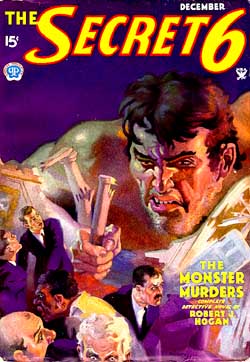
The advantage is the plotting of the stories. "The Monster Murders" is from December 1934, featuring a cover of a giant ripping the roof of a building and the Six scattering. A couple of the Six are on a walk when they come across dogs the size of horses running wild in the streets and aid the authorities in routing them. Meanwhile the Key and his contacts bring the Six a case of suicide and possible blackmails. As this puts them on the trail of two men, one over 6 feet and another over 7 feet, which leads them to even taller men that are impossibly tall, Key's case and the giant dogs seem obviously linked. And, it culminates in an exciting explosive finale. It's an exciting story, focusing mostly on the efforts of King and Key (who shares some of G-8's aide Nippy's sense of humor).

The reader will probably be ahead of the Six on figuring out a lot of what's going on in the story. And, with the science fiction plot, the fact that the Doctor is so under utilized other than as a Doubting Thomas and complain is a bit maddening. It makes him seem as if he doesn't bring that much to the table where the team is concerned in a plotline that you'd think would give him a lot to do and take a bit of the center stage. Another problem is that King and the team don't really treat the giants as "impossible" and follow up on the leads that it suggests or the obvious links to the giant dogs until near the end. It's one thing trying to find someone that's over seven feet tall, but once the giant is ten feet, eighteen, or forty, you're entering the realm of something un-natural going on. But, they continually approach it as aberrations but not necessarily un-natural.


An interesting aspect of the novel is the name, "The Monster Murders". One of Batman's earlies adventures pitted him against Hugo Strange and his giants, also identified as monsters in the story's titles. Most attribute this similarity to the Doc Savage novel "The Monsters", the cover featuring Doc being held in the grip of a giant hand and Bob Kane and Bill Finger are known to borrow from the pulps. This Doc novel has proved to be one of the more popular and enduring. Of all the covers, this is the only cover that Bama faithfully follows in his cover of the reprints. The story was also used to adapt for a radio script and was adapted in the 1970s Marvel color comic series with covers by Gil Kane and lush interior art by Andru and Palmer. The Doc story was first published in April, earlier the same year as the Secret Six novel. Is this a case of  Hogan borrowing from the Dent novel? It's possible that he was not as taken with Dent's efforts as Doc didn't really have to deal much with the giants as much in his novel, more with the gangsters behind them. Here, the team and society in general seem genuinely threatened with a nigh unstoppable threat, the Six outmatched.

Or, it could be a case that there's something in the water to prompt two stories of giant "monsters" in the same year. A little thing that was called King Kong in the theaters just the year before. In fact, the climax of the Secret Six novel seems taken right from the movie with the giant taking a lovely blonde as a prisoner and foresaking a cure in the hopes of making her the queen of the world and fighting attacking planes to the death.

There's even an earlier precedent to both of these novels. Three decades earlier, H. G. Wells writes the novel "The Food Of The Gods And How It Comes To Earth", dealing with humans transformed into giants and ultimately a war between them and the rest of humankind. In fact, "The Monster Murders" could be taken to have elements of another Wells novel, "The Island of Doctor Moreau".

Wednesday, December 15, 2010

The Mysterious Wu Fang (and Robert J. Hogan, too)


I finished reading two Wu Fang novels by Robert Hogan and have started an issue of The Secret Six. And, with the arrival of my new laptop, had hoped to bang out a review of the novels. Usually I like to start with a little background on the character and writer. Which was where I hit a snag.

Robert Hogan is a bit of an anomaly in the pulp authors' circle. Like Lester Dent, Walt Gibson, and Norvell Page he wrote a character pulp, the principle guiding force behind the character. For 110 issues, he wrote G-8 while the aforementioned contemporaries wrote Doc Savage, the Shadow and the Spider. Like those titles, G-8 has made a couple of forays into comics, several attempts at reprintings of his stories including some with excellent covers by Jim Steranko. However, Robert Hogan and his character were different from them in a significant way. One, I recall no mention of him using ghost-writers or what, if any, editorial involvement may have played in the creation of the character he is principally known for. Two, from the start, Hogan had his name on the cover. Every other major character pulp of the time was published under house names and pseudonyms. Yet, Hogan wrote at least three different title series under his own name: G-8, Wu Fang, and The Secret Six.

Maybe it's some ironic twist of fate, that the one author of the major hero pulps that wrote and was published under his own name is the one that the least has been published and written about. At the time of this writing, I'm newly married and most of my research books are at my old house a couple of hours away. But, I couldn't recall a single personal detail concerning Robert Hogan or behind the scenes of his stories. Yet, I can tell you that the creator of the Green Lama did magic tricks. Looking online for biographical data on Hogan was fruitless. The name is too common by itself, and coupled with his works bring up a lot of information on his books and characters, but nothing on him or his writing. Maybe it's the fact the other writers did slave behind house names that fueled interest in doing scholarly research in ferreting out the details behind the principle writers and their ghosts and replacements. As we are going through a revival of interest in the pulps and the characters, with several comic book companies trying new adaptations of them and more pulp reprints being offered than before, there is still precious little being written about G-8 and his creator.

As shown with The Octopus, Harry Steeger, the publisher of Popular Publications seemed convinced that a villain centered pulp was viable. Looking at the success of Fu Manchu, an Asian menace was opted for, Wu Fang. Robert Hogan was tapped to write it. It lasted a mere seven issues. Later, they'd try again with Dr. Yen Sin by a different writer and with even less success.

Wu Fang was a Chinese criminal mastermind who had designs for conquest, especially of America. He was a member of a few secret societies and had loyal henchmen of various races, most notably Chinese and Malaysian, and spies placed in key positions. He was a scientific genius who specialized in breeding various hybrid creatures that were intelligent enough to be trained as well as what could best be described as hybrid monkey men. He also had an assistant who claimed to have an ancestor as an ape, perhaps an early experiment of Fang's. He seemed to have a weakness for exotic white women and was able to exert some mysterious control, perhaps through brainwashing over them. There are two that we know of, Mohra and Tanya, both of whom would betray him after falling in love with his foes.

Wu Fang was most frequently opposed by Val Kildare. Kildare was more than likely somewhere between 30 and 50 years of age and well travelled. By the first novel, he had opposed Wu Fang several times but fails to capture him which leads to his official dismissal from the FBI, though he's allowed to keep his badge. He still enjoys some kind of  authority and he's referred to as being ex- Secret Service as well, but most frequently just as a "government man". Kildare is helped first by reporter Jerry Hazard and later archaeologist Rod Carson. Newsboy Cappy also serves as eyes and ears on the street.

Hogan was a good action pulp writer. With G-8, he showed that he could excel at realistic battle and action as well as thinking up outlandish plots. While fighting WWI, G-8 did the usual spy stuff but he also fought lost races brought to fight on the German side, bizarre death machines, science fiction weapons and devices and some that were merely mundane devices decked out with supernatural overtones. He brought that creativity to his writing of Wu Fang, thinking up fiendish tortures, outlandish creepy creatures created and controlled by Wu Fang.

Yet, the novels are lacking when it comes to the heroes and basic set-up. I've only once tried to read Rohmer's Fu Manchu and was bored by it. But there are familiar tropes that are carried through here. The Oriental criminal mastermind, the White government agent and his sidekick, the woman working for the villain but in love with the sidekick and her loyalties divided. Hogan doesn't only follow the trope, but he repeats it when he introduces a second sidekick, Rod Carson and his love-interest Tanya while Hazard is forced to retire with Mohra by his side from the fighting due to injuries received while being tortured by Wu Fang. What Hogan doesn't do is really describe the heroes or give them compelling characteristics or memorable traits.

To look for in depth characterization and motivation in most of the pulp literature would be a mistake, characters are painted with broad strokes, their appearances going hand in hand with their natures. Dent excelled at giving little character or personality bits to his characters to make them memorable. In the G-8 novels, Hogan wasn't often subtle but each of the principal characters were memorable in their own way. G-8 being the most generic, he had a favorite album he played to help relax and was sometimes given to philosophize over the nature of War, how some of the enemy he'd gladly meet over drinks in a cafe if times were different. Bull was large, loyal and a bit superstitious while Nippy was deft with his hands, cunning, witty, and a practical joker. That's all lacking here. We are told in "The Scarlet Feather" that Hazard is visibly younger than Kildare and that he's athletic. A similar description is given to Rod Carson in the other novel. But, that's it. The two are interchangeable and serve the exact same functions in the novels, following along on identical paths though the two men hold two entirely different jobs, Hazard is a crime reporter (and a detective in his own right) while Carson is an archaeologist. But, both talk with the same voice. While being the hero of the stories Kildare is described as an ex-FBI agent or Secret Service agent depending on the novel but still exacting some kind of authority. Otherwise, he's completely a blank slate, bumbling as often as the supposed sidekicks. His main trait seems to be able to be calm and not swayed by the attractiveness of the women while his chosen helpers are excitable and love-sick. The most distinctive of the lot is the plucky newsboy Cappy who helps them with information and even saves their bacon a time or two. Normally I don't like it when kid characters come on the scene as active participants in the stories, but here he's a breath of fresh air, his exuberance jumps off the page.

Of course, Kildare has other things against him that Hogan couldn't foreseen. He's so generic a character, it's hard to not mentally see his name and not think of either Dr. Kildare or Val Kilmer as you fish around for some characteristic or visual image to hook on him.

The traitorous women Mohra and Tanya don't fare much better. They are given little to do other than to look pretty and fret over whether to help their boyfriends or the mysterious crime-lord who holds some control over their lives. Mohra is described as being both exotic looking but also as a "white woman".Tanya is described as a blonde and speaks in a foreign accent. Another novel claims she comes from a royal family, kidnapped by Wu Fang.

Nee-Sa is a young Asian girl that also works for Wu Fang, although in her case it might be willingly. As such, her evil is a bit unsettling and un-natural and in "The Case of the Black Lotus" she disappears from a scene by possibly turning into a bat!

Which takes us to Wu Fang himself. In other novels and stories than the ones here, we get more background on the man and just how far he will go. For that history, I'll just point you to Rick Lai's outstanding article on him and Yen Sin. Yet, at least in these particular novels, we don't get much focus on the villain, he remains in the background, a motivating force until the end. Likewise, we have a lot of hybrid creatures and strange tricks such as Nee-Sa possibly turning into a giant bat, but little explaining how it's done or scenes of the man working in his lab, directing his minions, etc. He is as generic a menace as Kildare is a hero. Which sets up a vicious cycle. As we don't really see Kildare stand out as a detective ala Holmes, or mental/physical epitome ala the Shadow, Doc Savage, Jim Anthony, he never seems that big of a threat against Wu Fang. Likewise, Wu Fang never really shines as his opponent isn't all that special a character himself. It is interesting that one of the two novels I read actually used the term "Yellow Peril" in describing him as a character.

"The Case of the Scarlet Feather" and "The Case of the Black Lotus" are the second and sixth novels of the series. In "The Case of the Scarlet Feather", Wu Fang is up to something strange as he tips Val Kildare and Jerry Hazard to a plot to kill a cargo ship's cabin as well as an escape attempt by men he's holding in the ship's brig. Both events happen as planned, and seemed link to the theft of several caskets, the men involved being identified as foreign agents. Kildare soon discovers that it's linked to the formula for a powerful gas, recently discovered coating a scarlet feather in an Egyptian tomb.

"The Case of the Black Lotus" has Wu Fang usurping control of a secret Chinese society Chang Li, and using their sacred black lotus flowers as death symbols, pinning a widespread campaign of murder and terror on the leader of the secret society. Val Kildare, with the help of Jerry Hazard and archaeologist Rod Carson delve into the underground societies of Chinatown to find Fang's lair and stop him.

Both cases have mounting danger and bizarre menace through the various creepy hybrid creatures under Wu Fang's control. Both have intense scenes of the heroes trapped in buildings and allies getting killed one by one. While Hogan is not one for actual atmosphere, he describes action and settings with clarity. Wu Fang is a torturer and Hogan ably displays that without actually getting too graphic with the details, showing a possible talent for writing for some of the more graphic pulps. Interestingly, both covers feature the prominent method of torture in each story.

"The Black Lotus" is not the novel that Rod Carson and Tanya debut in, but their roles feature heavily as this is the novel that climaxes with Jerry Hazard being tortured to the degree that he may not fully recover for a long time if ever. If he and Mohra did return, it was in an unpublished adventure. Rod's plans for an archaeological expedition seem indefinitely derailed in his joining Kildare for the fight against Wu Fang and rescuing Tanya from his control.

Both novels are wonderfully illustrated, the first by Richard Flannagan, the illustrator of the Fu Manchu novels, and the second by Franz Plachy. Plachy wasn't as atmospheric as Flannagan, but he seemed to love drawing the heroes fighting scores of villains in exotic if cramped quarters and I prefer him over the other.

The end result is that as it was a short-lived series, I wouldn't mind reading the others, especially to get more of Wu Fang's background and character. Hogan is a master of plotting and telling a story, the adventures move at a break-neck pace. At the core, there's some interesting things going on with the characters that don't quite develop. As a steady diet, I'd probably find the blandness of the characters a bit tedious though wishing for Wu Fang to take on someone like Sherlock Holmes, the Shadow or the Green Lama. These two novels were reprinted in 1997 and 1999 by John Gunnison's High Adventure series.